The Vanishing Act of Esme Lennox by Maggie O'Farrell
This is a very visual book. The author evokes a series of fragmented images or pictures that remind me of an image as it would appear in a broken mirror. There are sharp, clear portions, but the complete image is difficult to see or bring into focus. You have to put some distance between the images and yourself before the fragments merge into a coherent image.
Consider the opening few sentences:
Let us begin with two girls at a dance.
They are at the edge of the room. One sits on a chair, opening and shutting a dance-card with gloved fingers. The other stand beside her, watching the dance unfold: the circling couples, the clasped hands, the drumming shoes, the whirling skirts, the bounce of the floor.
A similar picture is evoked in the last few pages of the story: "Two women in a room. One seated, one standing."
And in the meantime, more than sixty years have elapsed.
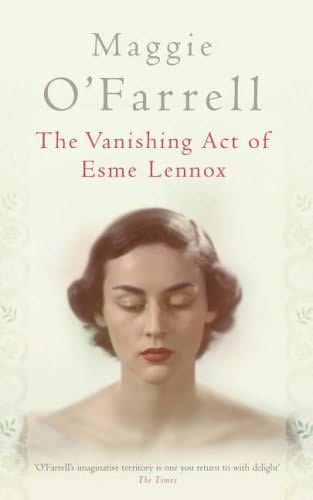 The two girls/women are Kitty and Esme, sisters. They were young women in Scotland in the 1930's,and sixty years later, Kitty is a grandmother with an Alzheimer-clouded memory. Her granddaughter Iris is stunned to receive a letter from a mental institution, explaining that her relative (one Euphemia Esme Lennox) is going to be released. Iris's father is dead and her grandmother is in no condition to explain to her who this person is, and why she has never heard of her before. In fact, she was certain that her grandmother, like her father and herself, was an only child...
But there is Esme, child-like and solid, and Iris cannot abandon her to the fate of a dilapidating system of care.
The action of the story takes place across just two or three days, as Iris discovers Esme's existence and brings her home for the weekend. However, the story spans more than sixty years, and is told in images and fragments from Esme's point of view, from Iris's, and from Kitty's broken and unsettled point of view.
Here is one bit from Esme's childhood memories. As I read through this, I was forcefully aware that a great deal of time was passing and that the child was clearly unsupervised. It definitely created the sense, by the end, that something was wrong, and indeed something was.
In the parlour, Esme wound the gramophone, stroked the velvet curtains, rearranged the chain of ivory elephants on the windowsill. She opened her mother's workbox and examined the threads of coloured silk. She rolled back the carpet and spent a long time sliding in her stockinged feet. She discovered that she could slide all the way from the claw-footed chest to the drinks cabinet. She unlocked the glass bookcase and took down the leather-bound volumes, sniffed them, felt their gold-edged pages. She opened the piano and performed glorious glissandos up and down the keys. In her parents' bedroom, she sifted through her mothers' jewellery, eased the lid off a box of powder and dabbed some on her cheeks. Her features, when she looked up into the oval mirror, were still freckled, her hair still wild. Esme turned away.
Esme was an intelligent, introspective girl--too independent to be satisfied with learning how to behave properly,and unwilling to accept that marriage was her only future. She was different, and in the end, her difference set her up for her fate: life in a mental institution.
It's hard to imagine any parents being able to lock a child away like that. Regardless of the culture and the times, I just cannot understand that. It was Esme's mother, I think, who was mentally disturbed, possibly because she had lost several babies. Her character isn't clearly seen, but I think there must have been something wrong with her if she could say of Esme, "we won't speak of her anymore..." and erase a daughter from her life entirely.
This is also Iris's story, although I don't think her part of the story was quite fleshed out as well as Esme's. I was left wishing there were one or two more chapters...
Labels: Books and reading
posted by Karen G. @ 12:59 PM
5 Comments


